
A decade defending the inner tube, and why I went tubeless anyway.
For ten years I told anyone who'd stand still long enough that a good clincher and a latex tube beat tubeless on any road worth riding. I was right. I'm now running tubeless. Both of those can be true at once, which is either the most useful thing I know about equipment or just a very long way of admitting I changed my mind.
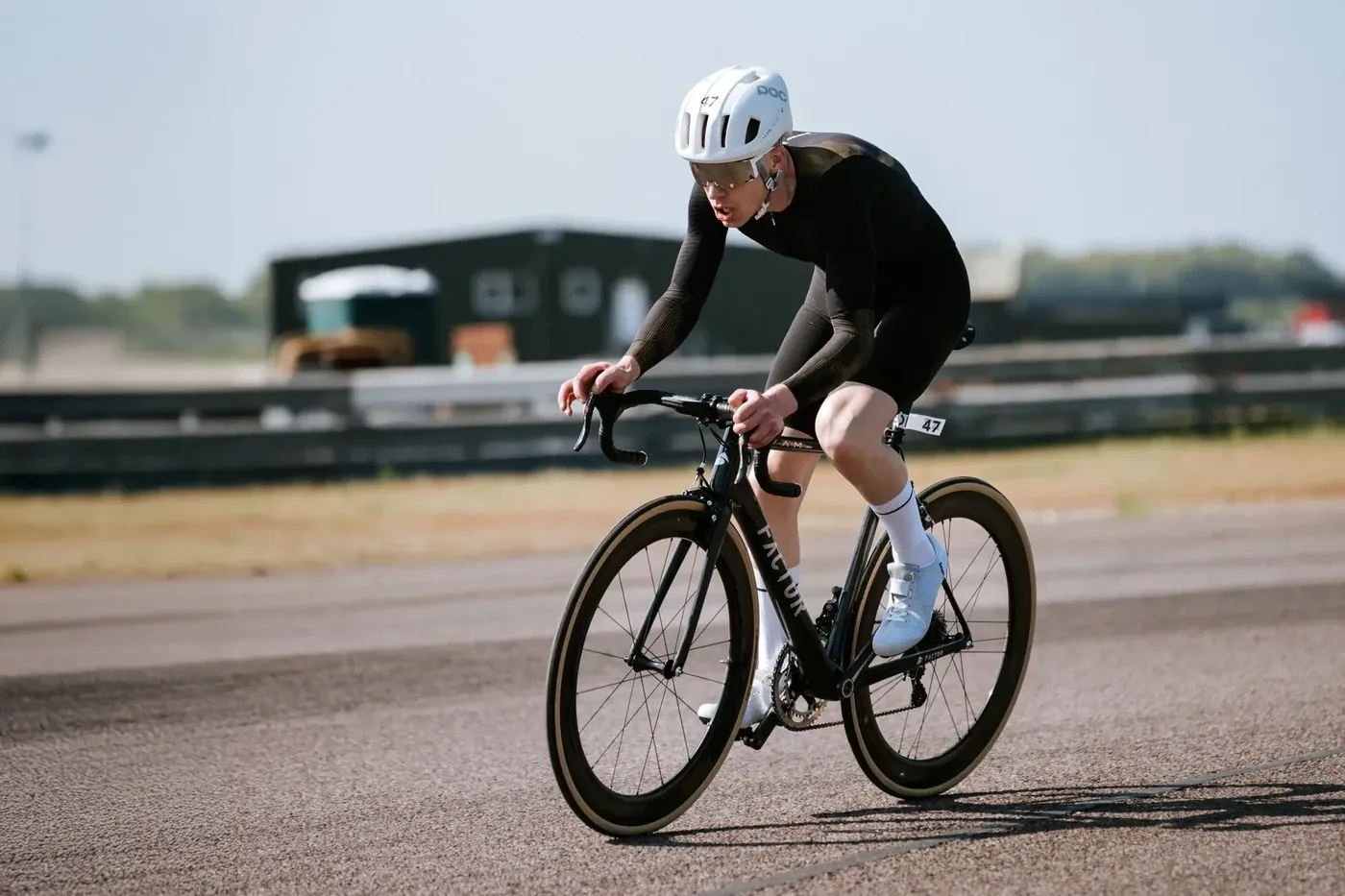
Tyre arguments are the closest thing cycling has to religion, which is a bit of a shame, because tyres are one of the few corners of this sport where the evidence is genuinely clear. To be fair, most people did gather the evidence, once, for one bike on one particular road, and they've been applying it to every surface they've ridden since.
So I'll make both cases properly, including the case against the thing I'm currently doing, and then tell you what I actually reckon. (There's a bloke on my club run who's been telling me tubeless was a solved problem for years, and I've spent those same years not listening to him. Hold that thought.)
Start with the weight, because it's the easy part
| Option | Weight | Notes |
|---|---|---|
| Butyl inner tube | 90 to 120g | The default. Also the slowest. |
| Latex inner tube | ~60g | Fast, porous, needs pumping daily |
| TPU inner tube | ~45g | Latex-level rolling resistance, packs tiny |
| Tubeless sealant | 30 to 50ml per tyre | The weight you cannot remove |
Run the numbers and a TPU tube against a tubeless setup saves you roughly thirty grams of rotating mass across two wheels, once you've counted the sealant. On a climb you'll feel that. On the flat, honestly, you won't, and that's the first clue that this whole thing is going to come down to conditions rather than a winner.
On rolling resistance, Zero Friction Cycling's testing is very clear about the bottom of that table: butyl is the slow one. If you're still on the standard butyl tubes that came with the bike, in 2026, that's the upgrade to make before you read another word of this. TPU sits level with latex, which is to say properly fast, and without latex's habit of wanting a pump every single morning before you've even had coffee.
The upgrade almost nobody makes is the cheapest one: stop riding butyl.
The case I made for a decade
My argument, for the record, was that the fastest riders in the world, in the events where they measure speed to the hundredth of a second, were doing exactly what I was doing. I was quite happy to hide behind them.
Tony Martin won the 2011 World Championship time trial on clinchers with latex. He took a Tour time trial stage in 2014 on an open tubular clincher, latex again. The 2016 Worlds, same construction, 24mm front and 26mm rear. Julian Alaphilippe won a Tour road stage on the same tyre in 2020. Then Kasper Asgreen won the 2021 Tour of Flanders on a 28mm version of it, over pavé, with a latex tube inside, which is the sort of thing that ought to be impossible. Chapeau to whoever was sat in the team car with the spares that day.
Specialized's own testing put the clincher and latex combination about ten watts up on the tubular setups it replaced. Remco Evenepoel was still winning world time trial titles on that construction into 2024.
So this was most of a decade of the sharpest end of the sport quietly choosing a tube, hardly a fringe position I'd talked myself into over a winter.
And then, in late 2025, Evenepoel switched to tubeless. Which was a bit awkward for me, obviously. Though the more useful reading is that the pros were simply making the same call over and over, race by race, without ever taking a position on it, and eventually the answer came out the other way.
What actually changed my mind
My rims did, rather than any watts chart.
For years I rode 25mm tyres on rims with a 19 to 21mm internal width. Tubeless on that setup is a compromise at best. The tyre isn't wide enough to run the low pressures that make tubeless quick in the first place, and the whole interface is more faff than anything that expensive has any bloody right to be. On that bike, on those rims, my decade of arguing was correct.
I now ride a 28mm rim with a 25mm internal width, and a 28mm tubeless tyre that measures 30mm once it's up to pressure. That changes all of the maths. The wide internal width lets me run genuinely low pressures without the tyre squirming about underneath me, and low pressure on an imperfect surface is where tubeless stops being a convenience feature and starts being free speed.
There's something the smooth-drum lab tests underrate, though. On a rough road, most of what you're losing isn't the tyre deforming at all. It's you, rattling. Vibration comes up through the frame and into your body and it costs you energy, and a supple tyre at a lower pressure soaks the road up instead of posting it straight into your elbows. On a British B road in February, I'll take that over thirty grams of rotating mass every time.
Nothing I believed about tubes turned out to be wrong. The road under them changed, and I changed with it.
The morning it all went wrong in Amsterdam
Before I get too pleased with myself, the thing that taught me most about TPU was a failure, and it was entirely my own doing.
Early morning, canal path, flat tyre. I had an electric pump and an early-generation TPU tube with a plastic valve, and I connected the pump straight onto the valve, no hose in between. Electric pumps get hot. Plastic valves, it turns out, are not remotely keen on hot. Sod's law had nothing to do with it. That was me, being an idiot, quickly.
The valve went soft. Then it melted, fused itself into the rim hole and became a permanent design feature of that wheel. No chance of fitting the spare either, because the hole was no longer a hole, so I walked back to the flat carrying a bike, in cycling shoes, clacking along a towpath like a man who has recently made a series of small decisions and got every one of them wrong. Not the morning I'd planned.
None of which makes TPU bad, mind you. Modern TPU tubes have mechanical valve attachments and welded joints precisely because the early ones failed like this. Every material has a way it prefers to fail, and it's worth knowing what that is before you're stood beside a canal at six in the morning with a wheel you've accidentally welded shut.
So: which one
Neither. Both. It depends entirely on the road under you, and not at all on the argument you had on a forum last winter.
Reach for TPU and a clincher when
- The road surface is good and predictable
- The day is defined by climbing, where rotating mass is felt
- You're chasing a time up a known climb, on a known surface
- You want a spare that weighs 45 grams and lives in a jersey pocket without a thought
Reach for tubeless when
- The surface is rough, patched, or genuinely British
- The ride is long and crosses varied terrain
- It's wet, and every bit of grit on the road ends up in your tyre
- You're a long way out and a puncture is a logistics problem rather than a delay
You'll notice the tubeless list describes almost every ride most of us actually do, and the TPU list describes the rides we're imagining at the exact moment we buy things. Sit with that one for a bit.
The idea underneath the tyres
For a decade I had the physics right. Where I went wrong was hanging onto the answer long after the things that produced it had quietly moved on. My rims, my roads, the products, the testing, all of it shifting quietly underneath a position I'd long since stopped re-examining.
It's the most common failure I see in riders who care about their kit, and I think it's a mindset thing rather than a knowledge thing. We do the research once, land on a position, then spend the next several years defending it instead of re-running the question. Defending it feels like expertise, mind you. That's the trap. Mostly you're just repeating yourself with better vocabulary.
Marginal gains are the habit of asking what's actually true today, on this road, in this weather, on this specific knackered morning, and it's a habit you never get to finish. (Which is, yes, the thing I spent a decade at Team Sky watching other people do professionally, and then somehow failed to do for myself on my own bike.)
Most of us can't hold that many variables in our heads on a wet Tuesday while also having a job and a bike that needs spannering. None of us can, really. It's why the pros pay somebody to do it for them.
Anyway. The bloke on the club run was right, and he's going to be completely insufferable about it, and I'm going to have to sit there at the cafe stop and take it. Worth it, probably. Ask me again in February.
Disclosure. I'm a SILCA ambassador and a fair bit of what I run is theirs. The figures above come from independent testing and from published professional equipment choices rather than from a brand deck, and I've named the sources so you can go and check them yourself. Weigh it up as you see fit.
Why this is here
Forma reads the conditions before you roll out and tells you what today actually asks for: the wind, the surface, the pressure, the fuel. It's the marginal gains department, working for one rider. One hundred founding riders, then the doors close.