
Only ten minutes of it actually hurt.
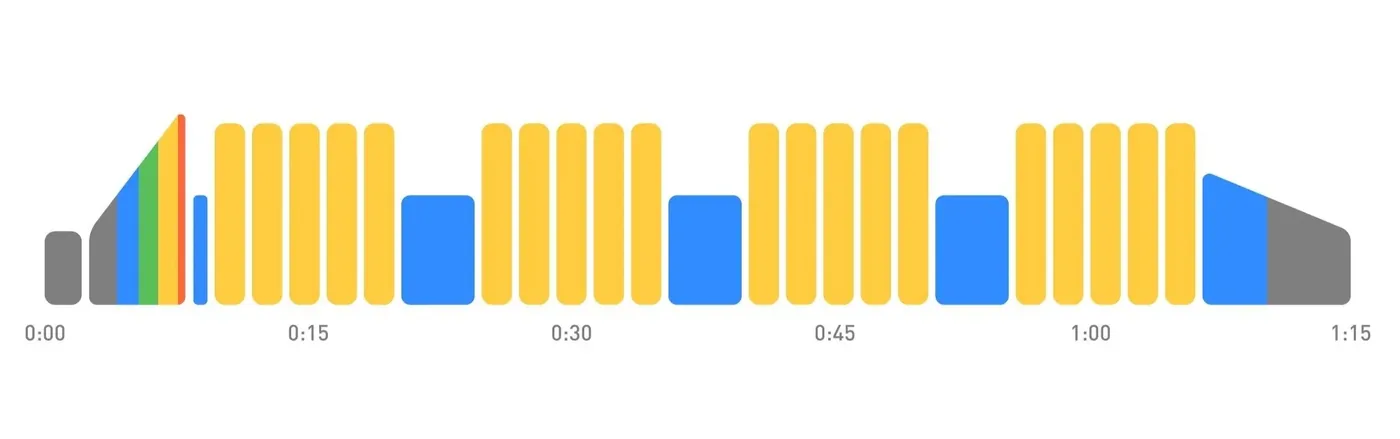
Seventy five minutes on the clock, forty of them at threshold. Somewhere in the second interval it dawned on me that almost none of the session was the problem, and that I'd been quitting things I was perfectly capable of finishing.

The session was four blocks of ten minutes at threshold, inside a seventy five minute ride. On paper that's nothing special. In the spare room though (spare room being generous, since it holds a turbo, a fan that sounds like a light aircraft on its take-off run, and nothing anybody would call furniture), at the point where you clip in and the shape of it comes up on screen, it looks like a wall.
That's the moment most sessions get lost, mind you. Everyone assumes it's the fourth interval, and it's actually the first thirty seconds, when your brain runs the numbers on the whole thing and concludes, quite reasonably, that this is going to be horrible for over an hour.
It isn't. And the gap between what the session actually is and what your head has already decided it will be is where most amateur riders quietly lose fitness they could have had. I know, because I've been one of them. I've knocked a session on the head at minute twenty two with a completely watertight explanation about how it was supposed to be an easy week anyway.
Do the honest audit
So take the seventy five minutes apart. Properly, with a calculator if you like.
The warm-up isn't hard, and it isn't supposed to be. Call it fifteen minutes of pleasant.
The recovery valleys between the blocks aren't hard either. They're actively nice, in that specific way that only exists about thirty seconds after you've stopped doing something difficult.
Cool-down, obviously not. And the first four or five minutes of each threshold block aren't hard, because at threshold you can sit on the power quite happily to begin with. That's more or less what threshold means.
So what's left?
10 minutes
The genuinely uncomfortable portion of a 75-minute session
Roughly the last two and a half minutes of each of the four blocks. Of those ten, maybe two to four are what an honest person would call pain.
Ten minutes out of seventy five, so thirteen per cent of the session, give or take. And the bit that genuinely hurts, the bit where your whole body is arguing with you, is two to four minutes spread across an hour and a quarter.
Everything else is just time and cadence.
You're not really quitting because it hurts. You're quitting because you've picked up all seventy five minutes at once and they're heavy.
The technique, which is almost embarrassingly simple
Look at the block instead of the session.
When I'm in interval two, interval four doesn't exist. It isn't on the horizon and I'm not doing sums about whether I'll still be alive when it turns up. There's this ten minutes, and there's the number I'm holding, and that's all there is until the timer says otherwise.
Then you run the same trick inside the block, just smaller. The first half is free. The third quarter is work. The last ninety seconds are the actual event, and ninety seconds is a length of time you can be certain about, because you can more or less count it out. I don't think anybody has ever been properly beaten by ninety seconds of anything.
Same thing outdoors. Don't stand at the bottom of Sa Calobra trying to take in the whole nine and a half bloody kilometres, because your head will render it as one continuous experience of suffering and start negotiating before you've turned a pedal. Ride to the next bend. There are twenty six of them, and every one of them is doable in a way the climb as a whole never is.
Why this works, and it isn't positive thinking
I want to be careful here, because there's an enormous amount of nonsense written about mental toughness and most of it is decoration. I spent a decade in rooms where we measured everything, including a fair few things that probably didn't need measuring, so I'm a bit allergic to the stuff that only sounds good.
Segmenting a session works for a fairly mechanical reason. What usually makes riders stop is the sums you're doing about how much more pain is coming, rather than the pain itself. Your legs only ever report right now. Your head reports a future it's made up, and the made-up one is always worse, because imagination hasn't got any data in it.
Shrink the frame to ten minutes, or to ninety seconds, and you starve that projection of the one thing it needs. You can't dread an hour you're not thinking about.
Which is why the sums above are worth doing on your own sessions rather than just reading mine. Once you've counted your own hard minutes, the number sits in your head as a fact instead of a reassurance, and facts tend to survive minute forty in a way that encouragement doesn't. Nobody printed ten out of seventy five on a motivational poster. I counted it, on a Tuesday, feeling fairly sorry for myself.
The sentence in the last thirty seconds
I only worked this next bit out later, after a decade spent around people who do it for a living.
At the point of maximum discomfort, your head produces a sentence. It's remarkably specific and it barely changes from one session to the next. Mine has been broadly the same for fifteen years. Yours will be too, and I'd bet money you've never actually listened to it, because by the time it turns up you're far too busy arguing with it.
So next hard session, try this. In the last thirty seconds of each block, catch the exact words. Don't argue with them, don't try to feel differently about them, just catch them.
Afterwards, write it down.
I know it sounds like a faff. Do it anyway, because two things happen. The first is that the sentence usually looks a bit pathetic in daylight, in a way it absolutely did not at the time. The second, and this is the useful one, is that once you know it you can decide in advance what you'd like to say back. Something small and instructional rather than slogan shaped, along the lines of settle the shoulders and hold the number for another thirty seconds.
Instructional self-talk beats motivational self-talk under load, every time. "Come on" is just noise, and so is "shut up legs", and I say that as a man who has tried both at volume. "Smooth circles, thirty seconds left" at least gives you a job to do.
The commentary in your head is old material. It was written by a younger, slower, considerably less fit rider, and nobody's updated it since.

The wider point
The reason any of this matters beyond the turbo is that most riders never find out what they were actually capable of, because they stopped. And the thing they stopped for was a version of the session that didn't exist.
A twelve-week block looks impossible in week one. Realistically it holds about thirty genuinely difficult sessions, each with ten hard minutes in it. That's five hours of discomfort spread across three months, wrapped in a great deal of pleasant riding, cafe stops and daylight.
Nobody can face twelve weeks, so face Tuesday, which has ten hard minutes in it, and which I'll be doing at seven in the spare room with that ridiculous fan going, waiting for the sentence to turn up and probably losing the first thirty seconds of the argument before I get on with it.
Why this is here
Forma coaches the part that quits first. It briefs you before the session, paces the intervals in your ear while you ride them, and debriefs what actually happened rather than what you feared would. One hundred founding riders, then the doors close.